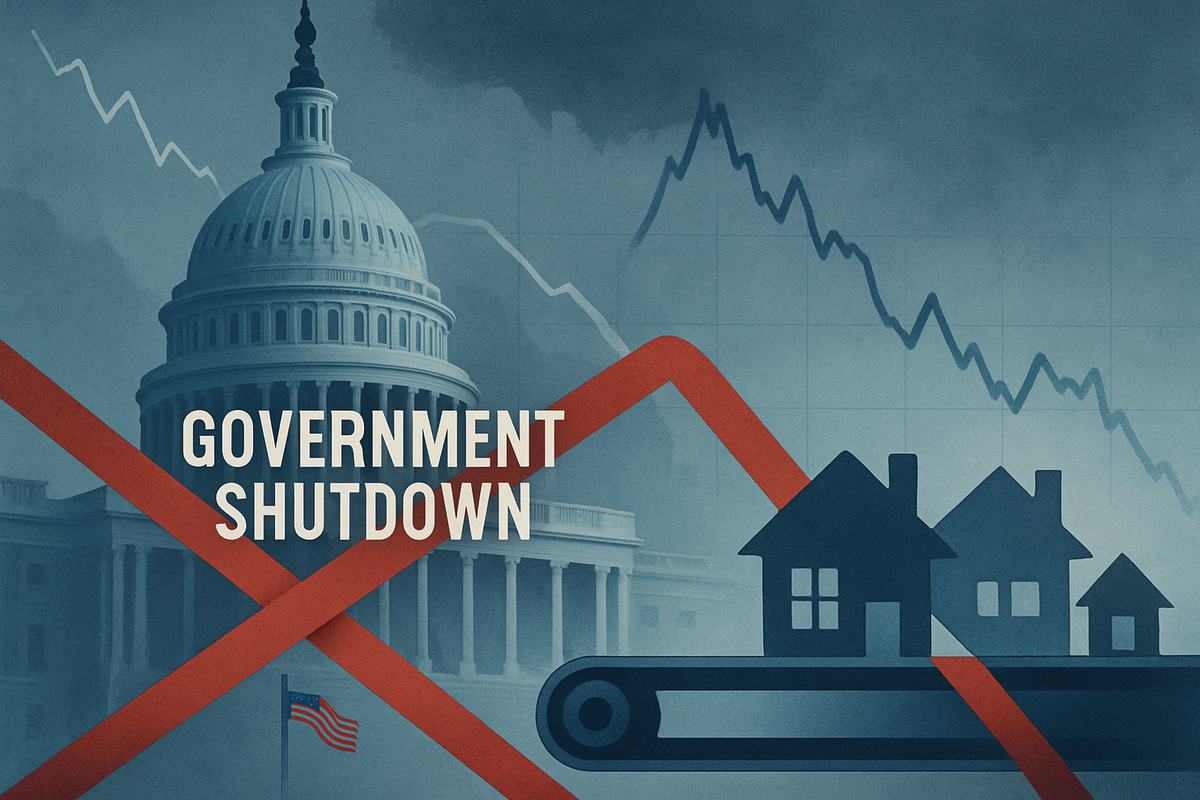
Government Shutdown Threat and Its Ripple Effect on U.S. Home Sales and Real Estate Investors
Every time the U.S. government faces the threat of a shutdown, anxiety spreads far beyond Washington, D.C. — it ripples through the economy, shaking confidence in sectors that depend on stability, especially real estate.
In 2025, with debates over fiscal policy once again escalating in Congress, investors are bracing for potential impacts on home sales, mortgage rates, and real estate investment returns. While shutdowns are often temporary, their consequences can linger, reshaping buyer sentiment and investor behavior for months.
This article breaks down how a potential government shutdown could affect the U.S. housing market, what it means for real estate investors, and how to strategically navigate uncertainty to protect — and even grow — your portfolio.
1. Understanding the Government Shutdown and Its Economic Impact

A government shutdown occurs when Congress fails to pass budget legislation to fund federal operations. As a result, non-essential government services are suspended, and federal employees face furloughs or delayed paychecks.
While these events are typically short-lived, even a temporary shutdown can disrupt critical processes tied to real estate, such as:
-
Delays in FHA and VA loan approvals
-
Slower IRS income verification for mortgage applications
-
Reduced consumer confidence
-
Uncertainty in financial markets
Historically, the longer the shutdown lasts, the greater the economic slowdown — especially in interest-sensitive sectors like housing.
2. How a Shutdown Disrupts the Real Estate Ecosystem
The real estate sector depends on a complex web of public and private institutions. When parts of the federal government pause operations, this ecosystem feels the strain in multiple ways:
a) Mortgage Market Bottlenecks
During a shutdown, the Federal Housing Administration (FHA) and Department of Veterans Affairs (VA) may suspend loan processing. This directly affects first-time homebuyers and veterans who rely on these programs for affordable financing.
b) IRS and Social Security Verification Delays
Lenders depend on IRS transcripts and Social Security data to verify income and identity. With those systems slowed or offline, mortgage approvals can take weeks longer — delaying closings and lowering transaction volumes.
c) Consumer Confidence Drops
Economic uncertainty makes buyers hesitant. Even those with approved financing may postpone purchases, anticipating falling prices or job instability.
d) Stock Market Volatility
Publicly traded REITs (Real Estate Investment Trusts) often see heightened volatility during shutdowns, as investors react to fears of slowed growth and weaker corporate earnings.
3. Historical Case Study: Shutdowns and Housing Market Reaction
2013 Shutdown: A Brief Dip
During the 2013 government shutdown, existing home sales dropped by nearly 10% month-over-month, according to the National Association of Realtors (NAR). Mortgage approvals slowed sharply as IRS and FHA operations paused.
2018–2019 Shutdown: Broader Economic Ripples
The longest shutdown in history (35 days) disrupted over 40,000 home loans, delayed closings nationwide, and caused a temporary contraction in mortgage-backed securities trading.
While markets recovered afterward, the data shows that prolonged uncertainty erodes consumer confidence, affecting not just transactions but long-term pricing expectations.
4. The 2025 Context: A Perfect Storm for Real Estate Uncertainty[

In 2025, the housing market is already facing:
-
Elevated mortgage rates (around 6.8–7%)
-
Tight housing inventory
-
High construction costs
-
Inflationary pressures on rents and home prices
A government shutdown could further strain these dynamics. For instance, if federal workers face missed paychecks, delinquencies in mortgage payments may rise temporarily. Moreover, potential buyers might hold off, creating a short-term dip in demand.
However, such dips can also present buying opportunities for strategic investors — especially those with cash reserves or access to private financing.
5. The Investor’s View: Risks and Hidden Opportunities
a) Short-Term Risk: Market Volatility
Property prices and REIT valuations may fluctuate as uncertainty peaks. Investors with leveraged positions could experience temporary equity losses.
b) Mid-Term Opportunity: Discounted Assets
Periods of uncertainty often lead to motivated sellers — developers, homeowners, or institutions looking to offload assets quickly. Savvy investors can identify undervalued properties and secure attractive entry points.
c) Long-Term Strategy: Stability in Rentals
If mortgage lending slows, fewer buyers can purchase homes, pushing more Americans into the rental market. This dynamic strengthens rental demand and offers stable income for landlords and multifamily investors.
6. How REITs React During Shutdown Periods
Publicly traded REITs often act as a real-time barometer for real estate sentiment. During past shutdowns, sectors like office and hospitality REITs were hit hardest due to their sensitivity to economic cycles.
On the other hand, industrial and residential REITs showed resilience, benefiting from structural demand (e-commerce logistics and housing shortages).
Investors focusing on diversified or defensive REITs may find relative safety during fiscal turbulence.
7. The Role of Interest Rates and Federal Reserve Policy

A government shutdown doesn’t automatically change monetary policy — but it can influence the Fed’s decisions indirectly.
If prolonged, a shutdown may cause weaker economic data, potentially prompting the Federal Reserve to pause or even lower rates to stabilize markets.
Lower rates could eventually stimulate housing demand, creating a delayed rebound effect for real estate transactions.
For investors, this underlines the importance of monitoring Fed signals closely during fiscal standoffs.
8. How Real Estate Professionals Can Prepare
1. Build Cash Reserves
Liquidity is key. Agents, developers, and investors should maintain enough cash flow to withstand temporary disruptions in closings or rental payments.
2. Diversify Financing Sources
Explore alternative lending channels — private credit funds, hard money lenders, or crowdfunding platforms — that are not directly impacted by government slowdowns.
3. Communicate with Clients
Transparency builds trust. Real estate professionals should explain how potential delays could affect timelines, keeping buyers and sellers informed.
4. Focus on Recession-Resistant Assets
Multifamily housing, self-storage, and healthcare properties often perform better during economic uncertainty.
9. A Look Ahead: What If the Shutdown Happens?
Should Congress fail to reach a deal, most analysts expect a temporary cooling in home sales lasting one to two months, followed by a gradual recovery once federal operations resume.
However, long-term fundamentals remain strong:
-
Structural housing shortage persists.
-
Millennials continue to enter the homebuying phase.
-
Institutional capital is flowing into build-to-rent and sustainable housing.
For disciplined investors, a government shutdown represents not panic — but preparation and positioning.
10. Strategic Takeaways for Real Estate Investors

✅ Avoid reactive selling. Market dips caused by political events tend to be short-lived.
✅ Watch REIT valuations. Volatility may create tactical buying windows.
✅ Diversify exposure. Balance property ownership with liquid assets.
✅ Leverage uncertainty. When others pause, strategic investors act.
By combining data-driven analysis with patience, investors can transform short-term instability into long-term opportunity.