America’s Two-Speed Economy: Why Wealthy Consumers Are Driving Growth While the Rest Are Falling Behind
The U.S. economy in 2025 tells two very different stories. On one side, wealthy Americans are spending confidently — buying luxury cars, traveling abroad, and investing heavily in real estate and financial markets. On the other side, millions of middle- and low-income families are struggling to keep up with rising prices, higher interest rates, and stagnant wages.
This growing divide has given rise to what economists now call “America’s two-speed economy” — an economy where prosperity and hardship coexist, and where economic growth increasingly depends on the spending habits of the rich.
In this article, we’ll explore how this phenomenon developed, what’s fueling it, and what it means for the future of U.S. growth, inflation, and inequality.
💡 What Is the Two-Speed Economy?
The term two-speed economy refers to an economy that grows at different rates across various income groups or industries. In the United States, it means that wealthier households are driving most of the economic growth, while the majority of consumers are cutting back due to higher costs of living.
According to the Federal Reserve, the top 20% of earners account for over 60% of all consumer spending in the country — a record high. Meanwhile, nearly 40% of Americans say they’re living paycheck to paycheck, even with unemployment near historic lows.
This divergence has reshaped everything from retail trends to investment patterns — and it’s creating a new kind of economic instability.
📈 The Wealth Effect: Why the Rich Keep Spending
Despite inflation and interest rate hikes, the wealthy remain largely insulated. Their spending power comes from three key factors:
1. Rising Asset Values
Stock markets have rebounded strongly after the 2022–2023 volatility, with major indexes like the S&P 500 and NASDAQ hitting new highs in 2025. Real estate and alternative investments, such as art and private equity, have also appreciated significantly.
This “wealth effect” — where rising asset values boost consumer confidence — allows affluent Americans to continue spending even as borrowing costs remain high.
2. Access to Cheap Credit
High-income consumers typically have excellent credit scores and more collateral, giving them access to low-interest credit lines and investment loans. While average credit card APRs hover around 22%, affluent borrowers often pay half that through private banking relationships.
3. Global Diversification
Many wealthy Americans benefit from global income streams, including offshore investments and foreign assets, making them less dependent on domestic market fluctuations.
The result: luxury goods sales, high-end travel, and exclusive experiences are booming — even as mid-tier retailers struggle.
🏠 The Struggle of the Middle Class and Low-Income Families
While the top 20% thrive, the rest of America faces persistent financial pressure.
1. Sticky Inflation
Despite cooling from its 2022 peak, inflation remains stubbornly above the Federal Reserve’s 2% target, especially in essentials like food, housing, and healthcare.
According to the Bureau of Labor Statistics, rents have increased nearly 25% nationwide since 2020, and grocery prices are up 35%. For families without significant savings, every dollar counts.
2. High Interest Rates
To control inflation, the Fed’s benchmark rate has stayed high — impacting credit card debt, auto loans, and mortgages. The average credit card debt per household has reached $7,900, according to Experian, the highest in over a decade.
3. Wage Growth Lag
While nominal wages have risen, real wage growth (adjusted for inflation) remains flat for most Americans. This means people feel poorer, even if they’re technically earning more.
The outcome is a consumer slowdown in key segments like fast fashion, dining out, and household electronics — industries that traditionally depend on middle-class spending.
💳 How Spending Habits Are Splitting the Economy
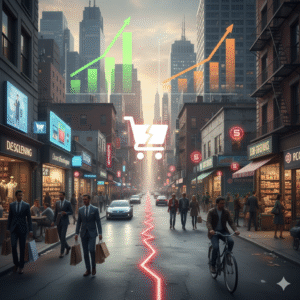
This divergence has created two parallel consumer markets:
| Segment | Spending Trend | Industries Benefiting |
|---|---|---|
| Affluent Consumers | Increased discretionary spending | Luxury retail, travel, real estate, finance |
| Middle & Lower Income | Reduced non-essential spending | Discount retailers, fast food, essential goods |
High-end brands like LVMH, Tesla, and Apple continue to post record profits, while mass-market retailers such as Target and Kohl’s report declining sales.
Meanwhile, companies like Walmart and Dollar General are seeing growth by catering to cost-conscious shoppers, illustrating how both extremes of the market are thriving — while the middle is shrinking.
⚙️ The Role of the Federal Reserve and Government Policy
The Federal Reserve faces a difficult balancing act. By keeping interest rates elevated to tame inflation, it risks deepening the divide between asset owners and wage earners.
At the same time, government stimulus programs — like infrastructure spending and green energy incentives — have disproportionately benefited wealthier investors who can afford to participate in tax-advantaged opportunities.
Some economists warn that without policies to address inequality, the U.S. risks a long-term structural slowdown.
“When growth depends too heavily on the top income brackets, it becomes fragile. One market shock can ripple through the entire system,” says economist Lisa Cook from the Federal Reserve Board.
🏦 The Corporate Perspective: Businesses Are Adapting
Corporations have taken notice of the two-speed economy — and they’re adapting fast.
1. Luxury Expansion
Companies like American Express, Delta, and BMW are doubling down on premium segments, launching exclusive rewards programs and higher-tier products for affluent clients.
2. Budget Optimization
On the other side, businesses serving price-sensitive consumers are expanding “value” product lines and subscription-based models to retain customers.
3. Data-Driven Personalization
Artificial intelligence and predictive analytics now allow companies to tailor pricing and promotions based on income brackets — a trend that could further reinforce the economic split.
🧭 Long-Term Consequences of a Two-Speed Economy

A sustained two-speed economy can have wide-reaching implications:
1. Lower Economic Resilience
If consumption becomes concentrated among the wealthy, overall economic stability decreases. Affluent households tend to save a higher percentage of their income, meaning less money circulates in the broader economy.
2. Political Polarization
Economic inequality fuels political division. As lower-income groups feel excluded from prosperity, social tensions rise — influencing elections and policymaking.
3. Reduced Upward Mobility
With higher costs of education, healthcare, and housing, the “American Dream” becomes harder to achieve for younger generations, perpetuating inequality.
🌍 The Global Context: The U.S. Isn’t Alone
This isn’t just an American problem. Other advanced economies, like the U.K., Germany, and Japan, are also experiencing similar bifurcations in spending and income distribution.
However, the United States stands out because of its consumer-driven economy, where consumption accounts for nearly 70% of GDP. That means disparities in spending power have a much greater macroeconomic impact.
🚀 What Could Change the Trend?

While the divide looks entrenched, a few key developments could help rebalance growth:
-
Monetary Easing: If inflation continues to cool, the Federal Reserve could begin cutting interest rates, easing pressure on borrowers.
-
Targeted Fiscal Support: Expanded tax credits or wage subsidies could boost lower- and middle-class consumption.
-
AI-Driven Productivity: If new technologies improve efficiency, they could reduce costs and increase wages across industries.
-
Financial Literacy and Inclusion: Encouraging investment and savings across all income groups can help democratize access to wealth creation.